

Field Dispatch: Good Mourning

When I was young, people would tell me I had my dad wrapped around my little finger.
I didn’t really understand what that meant—beyond that it was a badge of honor—and I have never had the best listening comprehension skills. So I went around bragging about how I was wrapped around his little finger to who ever would listen to me.
Both have proven to be true.
When I was 6 or 7, I’d wake up early just so I could sneak into his study to sit with him while he worked.
As a teenager in South Africa, he asked me more than once: “don’t you want to go out and party or something?”
Nope. I wanted to spend the day searching the outskirts of Jo’burg for the perfect antique table, then cook an elaborate meal and watch CSI: Miami with my dad.
After college, I lived in his windowless basement for longer than I like to admit.
When I eventually moved to New York, I made sure to get an apartment with enough room for him to visit.
In more recent years, we made do with weekly phone calls from wherever I was in the world and movie nights when I was back in town.
When I think about my father’s life, his identity was made up of three pillars that I know to be true.
My father was a physician, through and through. I truly believe it was his calling. He was the on-call doctor for everyone in our family, extended family or even just one-time acquaintances. As an emergency medicine specialist, he was baffled at having raised kids who got queasy at the sight of blood. When I cut my finger and refused to remove the towel wrapped around it to even look at the thing, he stayed with me on the phone until I got up the courage to peek at it, which had, of course, stopped bleeding long before.
He was often right in his diagnoses, able to quickly spot the difference between appendicitis and gas, a sprain or a tear. He’d often say to me: “Your tail is wagging, you’ll be fine.”
Sometimes he got it wrong—like when he told my mom to take Advil when in fact she had toxoplasmosis, a quite serious form of blood poisoning. And, of course, we never let him live that one down.
My father was also a South African.
Born to a Jewish pig farmer in Springs, he carried South Africa in his heart and his accent long after he left the country in 1964, at the age of 20. His sisters, Brenda and Sharon also left South Africa, and the three of them, “exiled by choice” as my father would say, kept in close contact as their lives unfolded. My father is the last of his siblings to pass, and he took care of both his sisters, in different ways, to the end.
This living memory of South Africa has been passed on to me and my siblings. My brother and I traveled for several weeks through the country, even getting matching tattoos in Cape Town, which my father never admitted to appreciating but I do think he got a kick out of it.
And, finally, my father was Jewish. He cared deeply about the Torah and its rituals. He found a community in his local temple and weekly Torah Study classes.
I asked him several times if he believed in God, for how tightly he was bound to Judaism, and maybe this isn’t the best time to rat him out, but he never had an easy answer for me. But those were the kind of questions he liked the best. Complex ones that left him thinking.
He was a voracious reader. Ever learning, ever curious. And he had a deep sense of what is right.
As a white South African whose father had profited from the Apartheid system, my dad carried shame about not having done enough. He cared deeply about helping people, often quietly going above and beyond.
He volunteered as a tutor for ESL learners and helped his weekly pedicurist finish her studies to become an RN. In his will, he has dictated for a portion to go to charity, selecting the Southern Poverty Law Center.
Beyond this, he put aside a portion for me and my siblings to choose our own charities to direct funds to, a detail so touching I know it will inspire a legacy of giving far beyond us.
I will ask that if any of you wish to donate in his honor, you do so at the Southern Poverty Law Center or a charity close to your own heart.
My father believed in the importance of history and place. As a family we visited lower Manhattan one month after 9/11.
During my gap year, my father hired a somewhat sketchy genealogist to take us around Riga, Latvia where our ancestors either fled or died in the ghettos.
On Christmas Day, back in 2012, my dad and I drove the two hours to Newtown, CT where we walked along the memorial of flowers and teddy bears for the 20 school children and six teachers who had been murdered in Sandy Hook elementary school two weeks before.
We grabbed a coffee and then drove the two hours back home.
These trips were never driven by any sort of morbid curiosity but a respect for history and a deep yearning to understand something from all sides.
I began training for my Antarctic expedition at beginning of my father’s decline. By the time I reached the South Pole, he had lost any understanding of what I had accomplished. But the greatest gift he ever gave me was the knowledge of just how proud he was of me. It was a pride predicated not on what I did, but the immutable fact of who I was as a person, deserving or not. He beamed when I showed him my photo on the front page of the Boston Globe. Despite no longer understanding Antarctica as a concept, there was no confusion as to why his daughter was in the newspaper: she deserved to be there, just for existing.
When my father passed away on April 18, I was there with my sister-in-law, Bea. We’d spent the previous 36 hours talking to him, playing Willie Nelson and Leonard Cohen, crying and laughing.
I held the phone near his ear so he could hear the calls from friends and family across the globe calling in to share a story or a memory with him, or to just thank him for the role he played in their life.
The night before, my sister, Taylor, had led my father’s final Shabbat. His eyes opened wide as my mother and I lit the candles, saying the blessing for the bread and the wine. The next time he opened his eyes, almost 24 hours later, it would be to take his final breaths, looking into my eyes as the Sh’ma, read and recorded beautifully by my cousin Helen, played next to his ear.
I imagine my father looking into my eyes as I took my first breaths over 36 years ago and it feels like some sort of divine justice that I was there to witness his last.
Our lives intertwined, wrapped around our little fingers, until the very end.
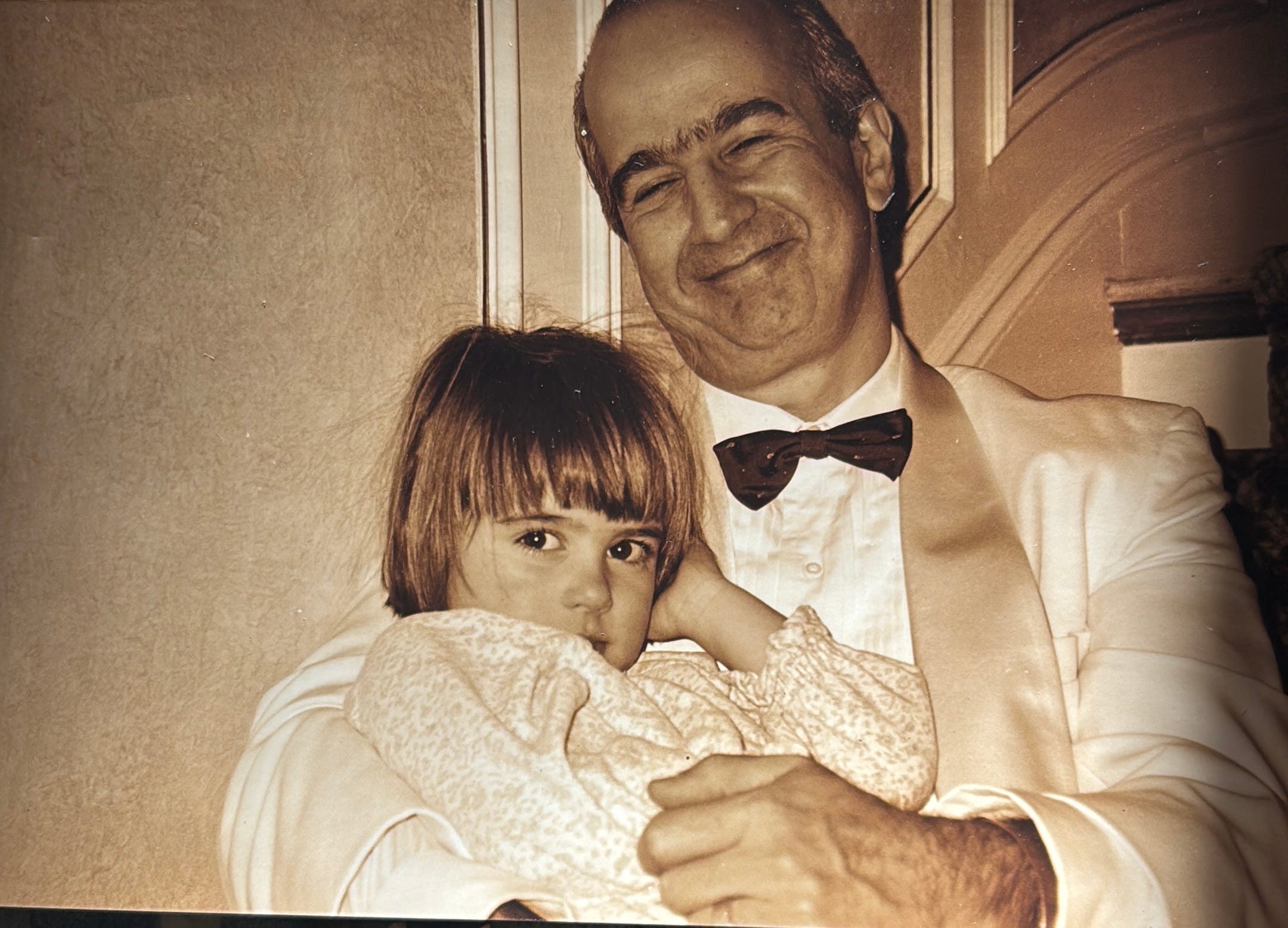
Michael Eliastam
Jan 3, 1944 - April 18, 2026
Beautifully written! You always talked about your dad with so much love, and this can be felt here well
Beautiful ❤️